What is on a Mexican acta de nacimiento
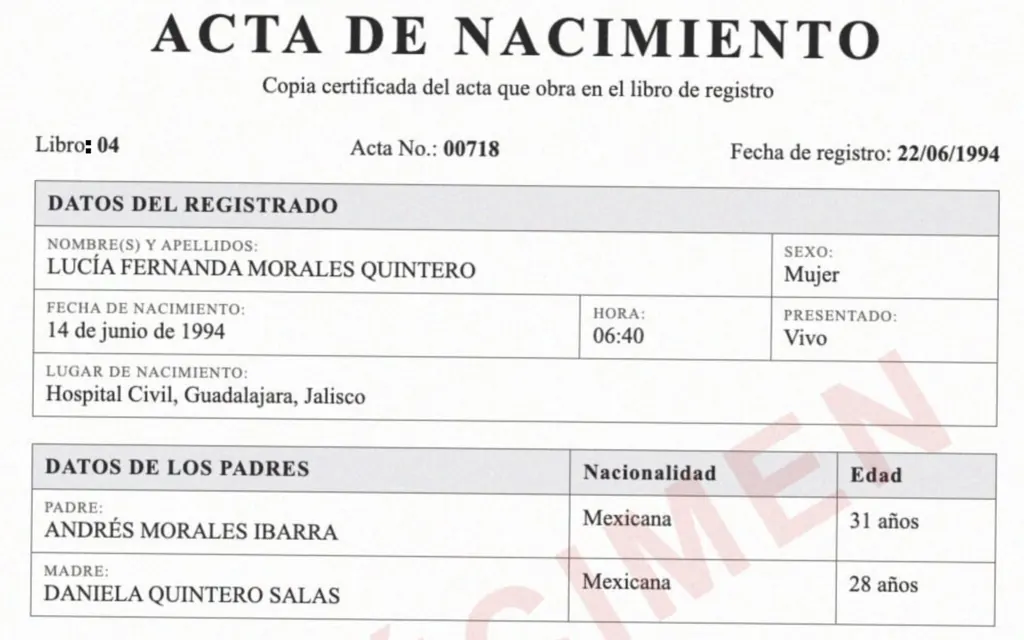
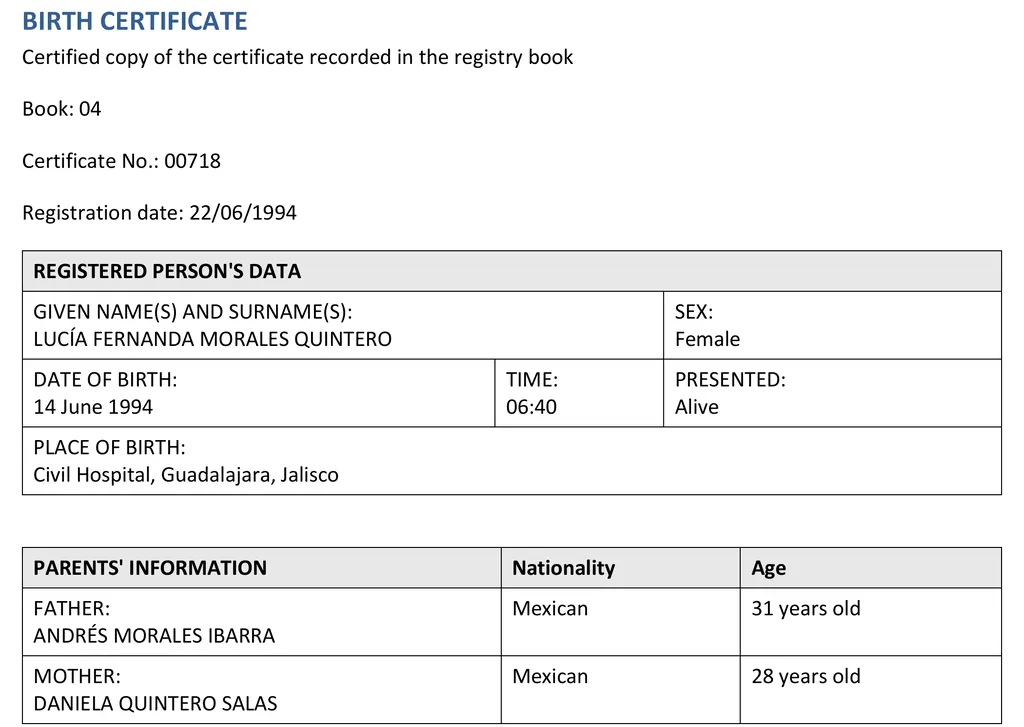
Mexico's civil registries issue birth certificates in one national layout, the Formato Único, which the national population registry (RENAPO) describes field by field in its manual[2]. It lists only the registered person and the parents, with the CURP of each, and it can be checked online[2]. Older certificates follow earlier state layouts. The specimen at the top of this page is one of those, with grandparents and witnesses, so match the fields to your own copy.
| On the certificate | What it is | In the translation |
|---|---|---|
| Estados Unidos Mexicanos, Acta de Nacimiento | The country and the name of the document[2] | United Mexican States, Birth Certificate |
| Identificador Electrónico | A 20-digit number that identifies this printed copy[2] | Electronic Identifier, with the digits copied as printed |
| CURP | The registered person's Clave Única de Registro de Población, a national ID code[2] | CURP (Unique Population Registry Code), kept as written |
| Entidad de registro; año, libro y acta | The state of registration, and the year, book and entry number of the record[2] | State of registration; Year, Book, Entry No. |
| Nombre(s), primer apellido, segundo apellido | Given names and the two surnames[2] | Given name(s), First surname, Second surname, never merged or reordered |
| Sexo | Masculino or Femenino[2] | Sex: Male or Female |
| Fecha y lugar de nacimiento | Day, month and year joined by de, and the state of birth[2] | 14 de junio de 1994 becomes June 14, 1994 |
| Datos de filiación | The parents' full names, nationality and CURP[2] | Parents' information |
| Anotaciones marginales | Later legal or administrative changes to the record[2] | Marginal notes, each one translated, or None |
| Certificación, Doy fe, Firma Electrónica Avanzada | The legal basis, the officer's attestation and an advanced electronic signature[2] | Certification, I attest, Advanced Electronic Signature |
| Código QR and número de validación | A QR code and a 20-digit number for checking the copy online[2] | [QR code], with the validation number copied |
Rules for translating it
- Translate the whole document, front and back, including stamps, seals and the certification text. USCIS asks for a full English translation[1].
- Keep names exactly as written, with both surnames and every accent. A name is not translated or anglicized.
- Copy numbers as printed: the CURP, the identifier, the book and entry numbers and the validation number.
- Spell out the month in every date, so a reader cannot take 06/05/1994 for June 5 when the certificate means May 6.
- Describe what cannot be translated in brackets, such as [seal], [QR code] or [illegible signature].
How to translate a Mexican birth certificate with LoreAI
- Get the certificate as a PDF or photo. A copy requested online through Mexico's national civil registry platform starts by choosing the state where the birth was registered[3]. A scan or a phone photo of a paper copy works too.
- Upload it and choose English. LoreAI reads the scan, translates it from Spanish and rebuilds the form's sections as Word tables.
- Check every field. Check the CURP, names, dates and margin notes against the original one by one. Correct the Word file where needed.
- Add the signed statement. The person who checked the translation signs a certification. The certificate of translation template has the wording.
Can I translate it myself?
The USCIS rule asks for a translator who certifies the translation as complete and accurate and certifies that they are competent in Spanish and English[1]. It does not exclude the applicant. USCIS's director has quoted agency guidance that anyone, including family members, can provide a translation as long as they certify their competence[4].
Ask a bilingual friend or relative to check and sign the LoreAI draft if you want someone other than the applicant to translate. That second reading also catches a swapped surname or a misread digit in the CURP.
Notarization and apostille
Neither the USCIS translation rule nor its filing instructions mention a notary or an apostille for the translation[1][5]. Send a legible copy of the certificate with the translation, not the original, unless USCIS asks for the original[5]. If a court or a foreign office asks for an apostille, follow that office's instructions.
Is there a template?
LoreAI builds the English version from your own certificate, so the fields match your document instead of a generic form. The birth certificate translation template has the usual fields in a blank layout you can fill in by hand. The Spanish to English guide explains common terms on other Spanish-language certificates.
Questions people ask
Do I need to translate the back of the certificate?
Should I translate the CURP?
No. Copy the CURP exactly and explain it once, for example as Unique Population Registry Code[2].
Does LoreAI keep both surnames?
LoreAI keeps names as written, including both surnames and accents. Check them against the original before anyone signs.
Is this a certified translation?
No. LoreAI gives you the English Word file. A person who knows Spanish and English checks it and signs the statement.
Sources
- 8 CFR 103.2(b)(3), Translations, Electronic Code of Federal Regulations, accessed November 2, 2026
- RENAPO: Manual del Formato Único de Acta de Nacimiento (PDF, Spanish), accessed November 2, 2026
- Plataforma Nacional del Registro Civil (Spanish), accessed November 2, 2026
- USCIS director's reply on translations for congressional casework, 2024 (PDF), accessed November 2, 2026
- USCIS: Five steps to file at the USCIS Lockbox, accessed November 2, 2026
By Matt Mountain ·