Which wording to choose
- USCIS
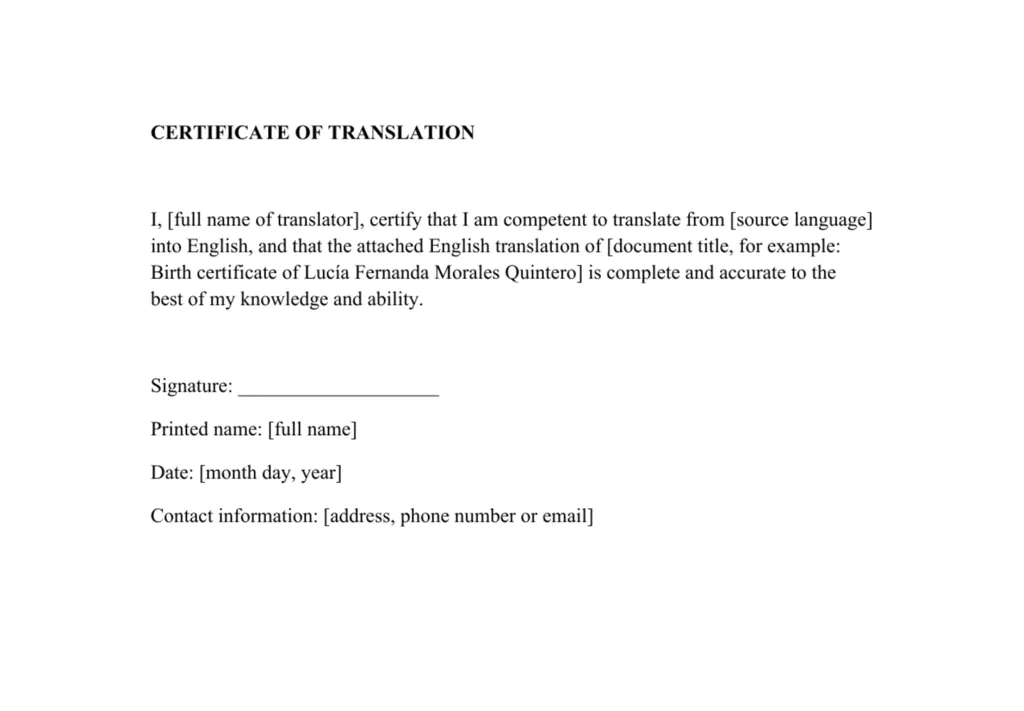
- For immigration filings in the US. The translation is into English, and the statement covers competence and accuracy as 8 CFR 103.2(b)(3) asks.
- General English
- For universities, employers, banks and other receivers that ask for a translator's statement in English, between any two languages.
- German Bestätigungsvermerk
- A template for translators sworn or authorized by a German court. Only they may sign it, with the place, the date and their round stamp.
The generator only fills in the wording. It does not check the translation, does not sign anything and does not make the statement official. You, the translator, sign it and answer for the translation. Nothing you type into the form is stored: the Word file is built when you press the button and sent straight to your browser.
Template
Free to use and share, including for clients. If you publish it, please link to this page:
<a href="https://www.loreai.org/certificate-of-translation-template">Certificate of translation generator</a>Put the certificate after the translation, on its own page or at the end of the last page. Print it, sign it in ink or with a signature your receiver accepts, and keep a copy.
Filled-in sample
The names in the sample are invented.
Where the wording comes from
USCIS regulation 8 CFR 103.2(b)(3) asks for a full English translation "which the translator has certified as complete and accurate" and "the translator's certification that he or she is competent to translate from the foreign language into English." The template states both. The I-130 form instructions add that the certification must include the translator's signature, printed name, the signature date and their contact information, so the template has a line for each.
Other receivers sometimes ask for extra wording or for the signature to be notarized. Add what they ask for. A notary confirms the identity of the person who signs and does not check the translation.
Before you sign
- Read the full translation once, so you can stand behind every line of it.
- Mention stamps, seals, signatures and handwritten notes in brackets, for example [Seal] or [Signature].
- Only sign if you know both languages well enough to stand behind the translation.
If you used LoreAI to produce the translation, you start from an editable Word file in the layout of the original, with names, numbers and dates as written. The person who signs the certificate answers for it.
Questions people ask
What is the difference between a certificate of translation and an affidavit of translation?
A certificate of translation is the translator's signed statement. An affidavit of translation is the same kind of statement with the translator's signature notarized. USCIS asks for the certification. Some other receivers ask for the notarized version.
Does the translator need credentials?
Not for USCIS, which has written that it does not require a professional translation service. Other receivers set their own rules. WES, for example, requires a professional translator.
Does this template work for a marriage certificate translation for USCIS?
Yes. The certificate is the same for any document. Name the marriage certificate in the statement, attach the full English translation of every page, stamp and note, and sign it. USCIS asks for that certification, not a special marriage certificate form. For the translation itself, the marriage certificate translation template lays out the fields.
Can one certificate cover several documents?
It is clearer to sign one certificate per document and name the document in it. That way each translation can be filed on its own.
Is there a Word version?
Yes. Fill in the form at the top to get a Word file with your details, or use the download button under the template for a blank one.
Can I use the German Bestätigungsvermerk if I am not sworn?
No. In Germany only a translator sworn or authorized by a court may confirm a translation this way. If you are not, use the general English wording, or ask a sworn translator to check and certify the translation.