What makes a translation certified in the US
A certified translation is an ordinary translation with a signed statement attached. The USCIS rule asks for a full English translation that the translator has certified as complete and accurate, together with the translator's certification that they are competent to translate from the foreign language into English[1].
The American Translators Association (ATA) says anyone in the United States can certify a translation. Translators do not need to be certified themselves[2]. There is no federal or state licensing or certification for translators[3].
- Who may sign
- Anyone competent in both languages, unless the receiver asks for a specific credential[3]
- What the statement covers
- The translation is complete and accurate, and the signer is competent to translate the language[1]
- What you send to USCIS
- A legible copy of the original plus the signed English translation, not the original itself[4]
- Notary
- Not part of the USCIS rule. A notary confirms who signed, not whether the translation is right[2]
What the certification statement says
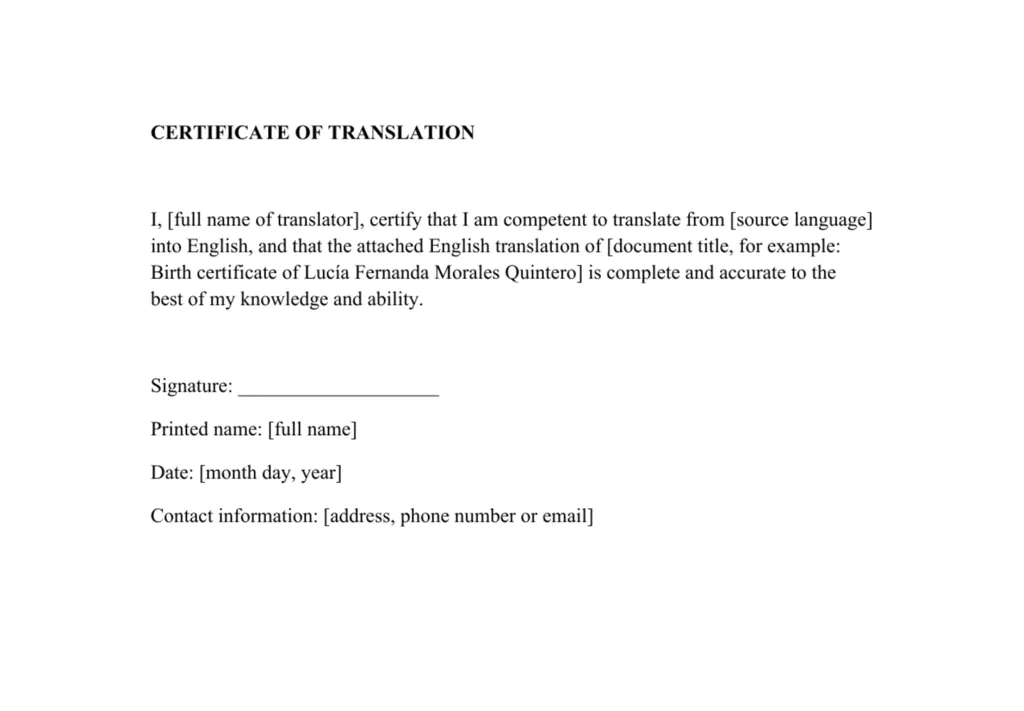
ATA lists what a statement should contain at a minimum: the translator's qualifications, a statement that the translation is complete and accurate, the document and language it covers, and the translator's name, signature and date[2]. If the signer reviewed someone else's translation instead of translating it, the statement has to say so[2].
For USCIS, the statement has to confirm that the translation is complete and accurate and that the signer is competent in the language pair[1]. The certificate of translation template has wording that covers both, ready to copy or download as Word.
Steps from a scan to a signed translation
- Get a clear copy of the original. Scan or photograph every page, including the back, stamps and handwritten notes. USCIS asks for a full translation, so nothing on the document can be left out[1].
- Make a draft translation. Upload the scan to LoreAI and download the English Word file. Names, dates and numbers stay as written, and the layout follows the original.
- Check it against the original. The person who will sign reads the draft line by line next to the original and corrects it in Word.
- Add the statement and sign. Put the certification at the end of the translation or on its own page, with the signer's name, signature and date.
- Submit it with a copy of the original. Send legible copies of official documents, not the originals, unless the office asks for an original[4].
Can I translate my own documents?
The USCIS rule does not say who the translator must be. It asks only that the translator certify the translation as complete and accurate and certify their competence[1]. In a 2024 letter, the USCIS director quoted the agency's casework guidance that anyone, paid or unpaid and including family members, can provide a translation as long as they certify that they are competent to translate from the foreign language into English[5].
If you can, ask someone else to sign. This separates the person who benefits from the document from the person vouching for its translation. A second reader also catches mistakes you would read past.
Certified, notarized and sworn are different things
A notary public only confirms the identity of the person signing the certification statement and does not check the translation[2]. Some receivers ask for a notarized certification on top of the signature. The USCIS rule itself mentions no notary[1].
Outside the US the rules differ. Under Germany's federal Administrative Procedure Act, an authority that receives a document in a foreign language asks for a translation, and in justified cases it can ask for a certified translation or one made by a publicly appointed or sworn translator[6]. The German state justice departments list those translators in a shared database[7].
Where LoreAI fits
LoreAI is not a certified translation service. It does not sign, stamp or vouch for a translation. It turns a scan or photo into an English Word file with the same layout. The person who signs can check and correct it without typing the document from scratch.
Your first document is free, up to 3 pages. After that, Basic is $12.99 a month for 200 pages, and you can translate into 105 languages.
Questions people ask
What is a certified translation?
A translation with a signed statement from the translator that it is complete and accurate and that they are competent in both languages[1].
Does a certified translation need a notary?
Do I need an ATA-certified translator?
Only if the receiver says so. In the US it is not necessary to be certified or licensed to provide a certified translation for official use, unless the receiver specifies an ATA-certified translator[3].
Can LoreAI certify my translation?
No. LoreAI produces the draft translation as a Word file. A person who knows both languages checks it and signs the statement.
Sources
- 8 CFR 103.2(b)(3), Translations, Electronic Code of Federal Regulations, accessed November 2, 2026
- American Translators Association: What is a certified translation?, accessed November 2, 2026
- American Translators Association: Certified translation vs. certified translator, accessed November 2, 2026
- USCIS: Five steps to file at the USCIS Lockbox, accessed November 2, 2026
- USCIS director's reply on translations for congressional casework, 2024 (PDF), accessed November 2, 2026
- Section 23 of the German Administrative Procedure Act (VwVfG), official language, accessed November 2, 2026
- Interpreter and translator database of the German state justice departments, accessed November 2, 2026
By Matt Mountain ·