What does the notary check?
The notary checks the signature, not the translation. The American Translators Association (ATA) says the notary public seal assures only that the signature is that of the person who appeared before the notary, and that the notary is not attesting to the accuracy of the translation[1].
ATA calls the phrase a misnomer because a translation itself cannot be notarized. What the notary acknowledges is the identity of the person who signs the certification statement[3]. Because the notary has to watch you sign, ATA tells translators not to sign the statement until they are in front of the notary[3].
How does a certified translation differ?
- Certified translation
- The translator signs a statement that the translation is complete and accurate and that they are competent in the language[2]
- Notarized translation
- The same signed statement, with the signature notarized by a notary public[1]
- What the notary confirms
- Who signed, not the accuracy of the translation[1]
- USCIS
- Asks for the translator's certification, with no notary in the rule[2]
- Who decides
- The office receiving the translation, which may ask for the translator's signature to be notarized[1]
Notarization adds proof of who signed a certified translation. Some offices want that proof before they act on a foreign document.
Does USCIS require a notarized translation?
No. USCIS requires a full English translation of any document containing foreign language. The translator certifies that it is complete and accurate and that they are competent to translate from the foreign language into English[2]. The rule says nothing about a notary.
You can notarize the statement for USCIS, but the rule does not ask for it. The USCIS translation guide covers what to send with the translation.
Who asks for a notarized translation?
Offices that need proof of who signed, often before a document goes abroad. The Texas Secretary of State, for example, will authenticate a translation only if it includes a statement from the translator whose signature is properly notarized, together with a copy or the original of the document that was translated[4].
The Hague Apostille Convention works the same way. Where a translation is not itself a public document, the translator may swear an affidavit attesting to its accuracy before a notary, and the notarial certificate then becomes the public document that can carry an apostille[5]. See apostille translation for the order of steps.
Other offices specify who can certify the translation. For a road test, the New York DMV accepts a translated foreign driver license only if a consulate, the US Department of State or another official government agency certifies it[6]. A notarized translation from a private translator does not meet that rule, so read the receiver's own wording before you pay for a notary.
ATA adds that some government entities that usually ask for notarized translations may accept a certified translation carrying the ATA-Certified Translator seal instead[3]. Ask the office if that applies.
How to get a translation notarized
- Make a draft of the translation. Upload a scan or photo of the document to LoreAI and download the Word file. Names, dates and numbers stay as written, and the layout follows the original.
- Have the translator check it. The person who will sign reads the draft line by line against the original and corrects it in Word.
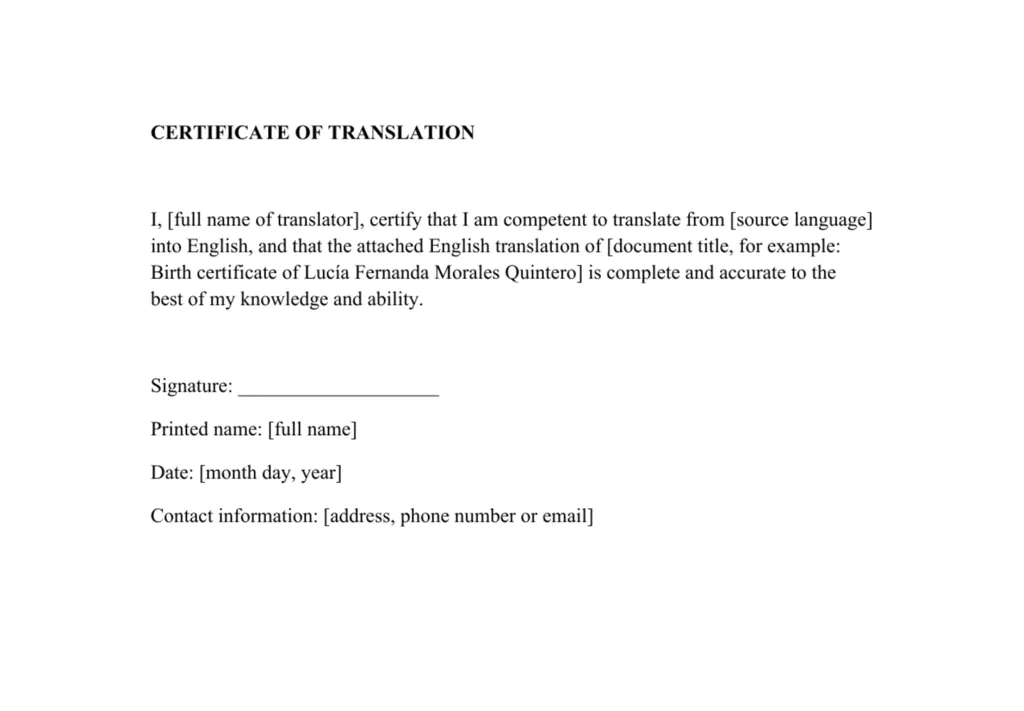
- Write the certification statement. ATA lists the minimum contents: the translator's qualifications, a statement that the translation is complete and accurate, the document and language, and the translator's name, signature and date[3]. The certificate of translation template has wording you can adapt.
- Sign in front of the notary. The translator brings an ID and signs while the notary watches, as ATA advises[3]. The notary then adds the notarial certificate.
- Attach the original or a copy. Offices such as the Texas Secretary of State want the translated document attached to the notarized translation[4].
Can I notarize my own translation?
If the receiver accepts an applicant's translation, you can sign the statement yourself before a notary. The notary only confirms who signed[1]. Many receivers do not. WES, for example, does not accept translations completed by applicants[7]. For USCIS, see the section on translating your own documents in the certified translation guide.
Where LoreAI fits
LoreAI is not a notarized or certified translation service. It does not sign, stamp or swear to a translation, and no notary is involved. It turns a scan or photo into a Word file with the same layout. The translator who signs can work from that draft.
Your first document is free, up to 3 pages. After that, Basic is $12.99 a month for 200 pages. For documents headed to a country with sworn translators, see sworn translation, and for birth certificates, certified birth certificate translation.
Questions people ask
What is the difference between a certified and a notarized translation?
Does USCIS accept translations that are not notarized?
Yes. The rule asks for a full English translation certified by the translator as complete and accurate, plus the translator's certification of competence, and mentions no notary[2].
Does a notary check whether the translation is correct?
No. ATA says the notary is not attesting to the accuracy of the translation, only to the identity of the signer[1].
Can LoreAI notarize a translation?
No. LoreAI makes the draft translation as a Word file. A translator checks and signs it, and a notary public notarizes that signature.
Sources
- American Translators Association: Certified translation vs. certified translator, accessed November 2, 2026
- 8 CFR 103.2(b)(3), Translations, Electronic Code of Federal Regulations, accessed November 2, 2026
- American Translators Association: What is a certified translation?, accessed November 2, 2026
- Texas Secretary of State: Apostille and authentication of documents, accessed November 2, 2026
- HCCH Apostille Handbook, paragraphs 195 to 197, translations (PDF), accessed November 2, 2026
- New York DMV: Drivers from other countries, accessed November 2, 2026
- WES: Translation requirements for a WES credential evaluation, accessed November 2, 2026
By Matt Mountain ·